Normandy's Quiet and Unspoilt Beaches
Think of Normandy's beaches and possibly the D-D landing beaches spring to mind. However the coastline spans a distance of almost 640km stretching from Le Tréport in the north east to Mont Saint Michel in the south west. It is broken up into various sections:
The Côte d'Albâtre (Alabaster Coast) is in the Seine-Maritime and takes its name from the high chalk cliffs that are part of the same geological system as the White Cliffs of Dover. The coast runs from Le Tréport through to Le Havre and includes coastal towns such as Dieppe, Fécamp and Étretat. Étretat is probably the most well known of the cliffs with its iconic arch.
The next coast is the Côte Fleurie in Calvados. This is a 40km long coastline from Honfleur to Merville-Franceville-Plage which is just to the east of the port of Ouistreham. Honfleur has a very picturesque harbour surrounded by brightly coloured tall and narrow town houses. Deauville and nearby Trouville-sur-Mer are very popular with Parisians due to good train links. It is probably most famous for the American Film Festival and a range of high-end boutiques, a casino and horse races. Further along, Cabourg is typified by sumptuous villas which you can admire from the 3.6km walkway (Promendade Marcel Proust). Although a relatively short coastline compared to others, the very popular towns attract a high number of visitors.
The five D-Day beaches cover the coast from Ouistreham in Calvados to Sainte-Marie-du-Mont in La Manche. The beaches of Sword, Omaha, Gold, Juno and Utah are certainly a draw to visitors. Many come to pay their respects and reflect on the significant role the beaches played in the events of 1944. Part of this coast is known as the Côtes de Nacre et du Bessin.

The photo above is of the temporary art installation Standing With Giants overlooking Gold Beach.
The Cotentin Peninsula is the part of Normandy that projects out into the sea and includes the port of Cherbourg. It’s a mix of pretty villages on the east side such as Barfleur and Saint-Vaast-la-Hougue and a more natural and rugged feel on the west side. Part of the western coast is the Côte des Havres stretching from Carteret to Granville - a series of 8 natural harbour inlets.
Finally, from the granite cliffs at Carolles and Champeaux you’re treated to a view of Mont Saint Michel Bay and the island.

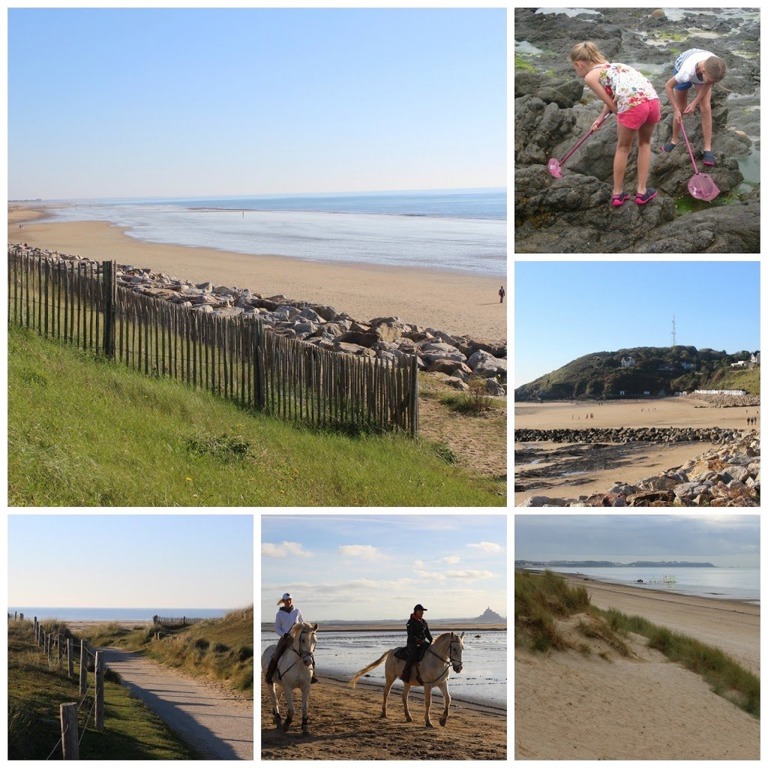
The pictures above were taken along the Côte des Havres. The Harbour Coast stretches from Granville to Barneville-Carteret. As well as 8 harbours, this coast is known for its sandy and shingle beaches. There are also low dunes behind which quaint villages nestle. Some of the beaches have wide pedestrian walkways which pass in front of the seaside properties. The beaches are generally quiet. And often so quiet that you wonder why no-one else has realised how glorious they are.

For those who enjoy being by the sea, Normandy's beaches will allow you to explore and enjoy the extensive and unspoilt coastline.