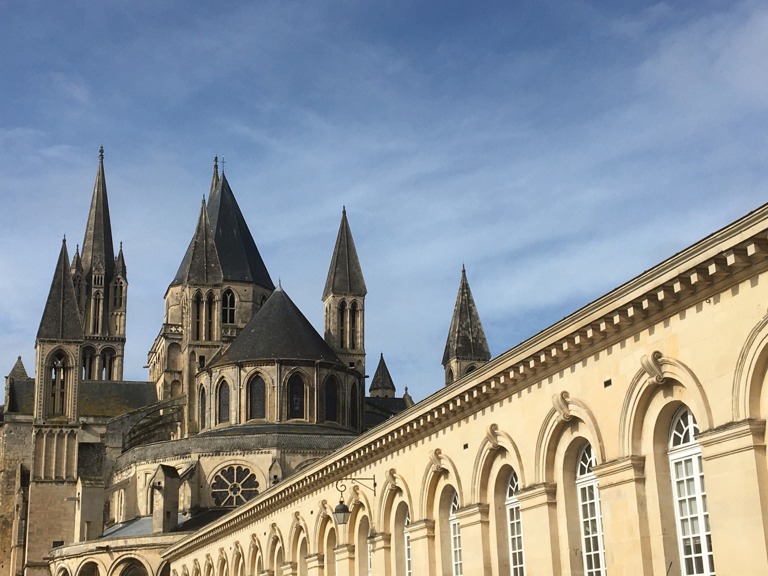
The Men's Abbey in Caen was founded in 1063 by William the Conqueror. There are two key parts to this magnificent building which is known as l'Abbaye aux Hommes in French
The first is the abbey church of Saint Etienne and this is where William was buried. The church is free to visit and is a wonderful example of 11th century Normandy Romanesque art. The church was consecrated in 1077 in William's presence. The abbey is a former Benedictine monastery and is dedicated to Saint Stephen. It was founded in 1063 by William the Conqueror and has one of the largest Romanesque churches in France.
Building the Abbey Church
William founded the abbey in 1063 and building began in 1065/1066. It was almost complete in 1077 and therefore was consecrated that year on 13th September in William’s presence. Only the last two bays of the nave and the West façade with its two towers were still to be built. These additional features were completed in 1090. William chose Caen as he wanted to make the town the capital of the Duchy of Normandy. The building work was rapid due to funding received following the Battle of Hastings as well as readily available materials such as Caen stone and wood.The size of the church is incredible and it has the grandeur of a cathedral. It measures 110 meters long and over 42 meters wide at the transept. The North tower is the tallest at 82 meters. Architectural Style and History
The Romanesque nave dates from the 11th and 13th centuries. An important ribbed vault featured was added in about 1120, and was the first time it had been used in France. This abbey, together with the nearby Abbaye Aux Dames, is considered to be a forerunner of the Gothic style. The original Romanesque apse was replaced in 1166 by an early Gothic chevet, complete with rosette windows and flying buttresses. Nine towers and spires were added in the 13th century. The choir was rebuilt in the thirteenth century in a Gothic style.Architectural details of note include the galleries on the first and second levels: the Halbout Chapel; the clock in the North transept gallery installed in 1744; the grand organ made in 1744; the lantern tower; and the rail surrounding the choir. The high lantern tower in the middle of the church collapsed during the Wars of Religion and was never rebuilt. During the French Revolution, the abbey church became a parish church.From 1804 to 1961 the abbey buildings accommodated a prestigious high school called the Lycée Malherbe. During the Normandy Landings, thousands of Caen inhabitants found refuge in the church. The Allies were made aware of this and placed a red cross made from a sheet on the rooftop. This showed that it was a hospital and a safe haven. As a result the abbey church was not destroyed during the bombings which took place in July 1944. However, the nearby church of Saint-Étienne-le-Vieux was damaged and remains in its ruined state today.The Tomb of William the ConquerorWilliam’s wife Matilda died in 1083 and was buried in the Abbaye aux Dames in Caen. In 1087 William died in Rouen and his body was sent to Caen to be buried in the abbey church as he had requested. When William commissioned the abbey church to be built, he had already decided that it was to be his mausoleum.His tomb has been disturbed several times since 1087. The first time was in 1522 when the grave was opened by envoys from Rome. In 1562, during the French Wars of Religion, the grave was again opened. William’s bones were scattered and lost, with the exception of one thigh bone. This single relic was reburied in 1642. A further destruction of the tomb happened during the French Revolution. The current white marble marker replaced it in the early 19th century. You can see the marble stone in the choir today. It is inscribed in Latin with the words ‘Here is buried the invincible William the Conqueror, King of England and Duke of Normandy; founder of this house, who died in the year 1087.'
’ T
T
After a series of disasters, the monks of Saint Maur took over the abbey in the late 17th century and decided to rebuild all of the abbey buildings. The Abbaye-aux-Hommes became the City Hall (Le Mairie) in 1963. You can take a paid tour of this 18th-century building. You can visit this site for more
information about tours of the abbey
Practical InformationThe abbey church in Caen is on Esplanade Jean-Marie Louvel. You can also access it via rue Guillaume le Conquérant – a small side street leads to the equally small entrance door. Entry to the abbey church in Caen is free. You can visit from Monday to Friday from 9am – 6.30pm, Saturdays from 9am – 6pm and on Sundays from 2 – 6.30pm.
The second part is the abbey itself and is made up of a series of buildings used by the Benedictine monks for prayer and everyday monastic life. These buildings are attached to the church and are now used as the City Hall. You can take a self guided tour or a guided visit of some of the ground floor buildings. Both tours are very reasonably priced and details are in the practical information section below. The buildings are impressive both inside and out and represent a walk through centuries of history.
The Creation of The Abbey
In 1050/51 William married his distant cousin Matilda. However, their union was frowned upon by the church and relations between Normandy and Rome were strained. Mediation towards the end of the 1050s led to a pardon from the Pope but with some conditions. As a penance, William was ordered to build two abbeys and four hospitals. The four hospitals were built in Caen, Bayeux, Rouen and Cherbourg. Both the abbeys were built in Caen and are the Men's Abbey and the Ladies' Abbey built respectively by William and Matilda.
The abbey was founded in 1063 and consecrated on 18 June 1066. On 25th December in the same year William was crowned as the King of England following the Battle of Hastings. The majority of the church was built between 1065 and 1077 and consecrated later that year. This intense building period was due to William's rise in importance and the fact that building materials were readily available nearby. The Ducal Palace was built in the 14th century and this is at the rear of the abbey.
The Demise Of The Abbey
Between 1562 and 1563, the monastic buildings were badly damaged during the Wars of Religion. They were no longer able to accommodate the monks and, as a result, were demolished at the end of the 17th century. The bakery, apple press, coach house, Ducal Palace and the Guard's Hall weren't affected and still reflect the medieval origins of the abbey. The abbey buildings that you see today were rebuilt in the 18th century.
One of the permanent exhibitions at the abbey is entitled Anglo-Normand World. It looks at the links between Normandy and England from a religious and also an architectural perspective. Visitors can also read information about the abbey's founding charter, property acts and deeds. You can view a copy of a charter with William's signature on it. Plus, take a look at the seals used by William and other nobility including Richard the Lionheart.
Taking A Self-Guided Tour
This option is called 'une visite decouverte' and you stroll around by yourself. You'll find the times and tariffs below. There are information boards in both French and English. Both the exhibitions in the abbey also have bilingual display boards explaining the key points. There is also the option to listen to an audio recording in English of the first exhibition. As you go in through the main entrance, the ticket office is just to the right. You'll be given a small leaflet that has a plan of the route you take.
Warming Room
The first stop is the Calefactory or Warming Room. In French it is known as the chauffoir. The permanent exhibition about the Anglo-Normand World is set up here. A key feature of this room is the fireplace and is how the room got its name. It was one of the few rooms in the abbey that was heated. Benedictine monks lived their everyday life without comforts of any kind including heating.
The Cloister
Next you make your way into the cloister. I was lucky enough to be the only person taking the abbey visit so was able to enjoy the peace and quiet and enjoy the beautiful architecture. The cloister is relatively simple in design and is built in a Tuscan style.
Services Board
The Services Board is stop 3 on the tour. It's a carved oak board dating from 1744. The four columns indicate the times when the monks had to worship and the tasks they had to do during the services.
The Gatehouse
The former gatehouse (porterie) houses the second permanent exhibition. The gatehouse would have been the original entrance to the abbey as it led through to the parlour. It was also opposite the Ducal Place where important guests were accommodated. The exhibition looks at the events of the summer of 1944 following the bombings. Photos, texts, letters, audio and video accounts show how Caen inhabitants went about their everyday life until the city was liberated. There is one of two staircases in this room and you also get to see the other at the end of the tour.
After that you retrace your steps and return to the entrance hall. From here you can go through and admire the grand staircase. It leads to offices so you can't go up to the first floor. However, if you peer through the window on the left hand wall you can catch a glimpse of the Guard's Room. La Salle des Gardes was built in the 14th century and was used as a reception room for guests. It acquired its current name in the 18th century despite never being a garrison for troops.


The Scriptorium
The final part of the tour is the Scriptorium and is where the monks studied and copied manuscripts. Temporary exhibitions are held here although there wasn't one on when I visited. You can still go into the room which is light and airy as it has large windows along two of its sides.
You can browse the shop housed in the main entrance hall before you leave.
A Guided Tour
These 50 minute tours don't need to be pre-booked but may be busier during the summer months. There are also a series of themed tours throughout the year in French. Taking a guided tour will allow you to see additional rooms in the abbey. They include the Guard's Room, the apple press, the refectory, the parlour, the sacristy and the chapter house. The chapter house is known as the Salle Capitulaire and is where marriages take place nowadays. If there's a specific room you're interested in visiting, check whether it's included on the regular guided visit or a themed one.
The Sacristy leads through to the church and I was fortunate enough to get a glimpse of it. I happened to be passing as the door was unlocked by a member of staff. This room is where vestments, church furnishings and sacred vessels are kept.

Practical Information
Details of the self guided tour, the 50 minute guided tours and the themed guided tours are on the Caen Mens' abbey website.
Top Tips
-
Check the opening times before you visit as they differ throughout the year
-
Consider visiting either early in the morning, over lunchtime or later in the afternoon as it may be quieter
-
Ask for a leaflet in English if you're doing the self guided tour
-
Only go into parts of the abbey that you're permitted to.
-
There are restrooms at the far end of the Scriptorium
The Men's Abbey in Caen is on Esplanade J M Louvel.